Where the RTP figure actually lives
The fastest way to check a slot’s RTP is the in-game info screen — tap the “i” icon, paytable button, or settings menu (usually bottom-left on desktop, inside the main menu on mobile) and look for a line that reads “Return to Player” or “RTP” next to a percentage. Most licensed studios build this into the help pages by regulatory requirement, not courtesy: it sits alongside the paytable, feature rules, and volatility rating. If the game doesn’t show it there, that’s itself a signal worth noting before depositing.
Beyond the client, three other places carry the number:
- Studio game-information sheets. Providers such as NetEnt, Play’n GO, and Pragmatic Play distribute PDF “game sheets” to licensed operators covering math model, hit frequency, volatility index, max win multiplier, and every certified RTP configuration for a title. These aren’t usually posted on the studio’s public marketing site, but operators sometimes mirror them in a help center or game-rules PDF linked from the lobby.
- Regulator records. The UK Gambling Commission doesn’t run a searchable per-game RTP lookup — its Public Register lists licensees and premises, not individual slot math. What the Commission actually requires is that the operator disclose the RTP to players (on the machine, on a help screen, or in game information) and that an approved test house verify it before launch. The regulatory trail proves the number was checked, not what the number is.
- Third-party RTP databases run by casino-review sites and slot trackers. These pull figures from game sheets, casino lobbies, or their own testing and are useful for quick comparisons, but quality varies a lot — treat them as a lead to confirm in-client, not a final source.
Telling a studio-published number from a guess
A legitimate RTP figure traces back to a specific, named source: the game’s own help screen, a provider’s official game sheet, or a test lab certificate (eCOGRA, iTech Labs, GLI). If a number only exists on a blog post with no citation, no version noted, and no date, treat it as an estimate rather than fact.
Three checks separate a real figure from a guess:
- Does it match the in-game screen? The paytable or info panel of the actual client you’re about to play is the ground truth for that session — not a wiki entry, not a forum post from two years ago.
- Is a configuration or version noted? Because many titles ship in multiple certified RTP tiers (more below), a number without “standard configuration,” “default build,” or a specific percentage range attached is incomplete. “96% RTP” without qualification on a title known to have variants is a sign the source didn’t check the live build.
- Does the source distinguish theoretical from observed? Theoretical RTP comes from the math model and certification. “Observed” or “actual” RTP some sites quote is a live-tracking estimate over however many real-money spins they sampled — informative, but a different thing from the certified number, and it should say so.
Why the same slot can show different RTP numbers at different casinos
Many online slots are built, certified, and shipped in more than one RTP configuration, and the operator — not the player, and not chance — picks which one goes live. This is well documented for several major studios. Pragmatic Play titles are commonly supplied in roughly three certified tiers (figures around 96.5%, 95.5%, and 94.5% recur across its catalog, though the exact set varies by game), and the operator selects one per market or per brand. Play’n GO is reported to certify a wider spread of configurations for many titles — the same slot can appear well above 96% at one operator and several points lower at another, with identical reels, art, and features; only the long-run payback changes. NetEnt has historically published relatively conservative default RTPs but also offers adjustable configurations on a number of titles, distributed to operators as separate certified builds.
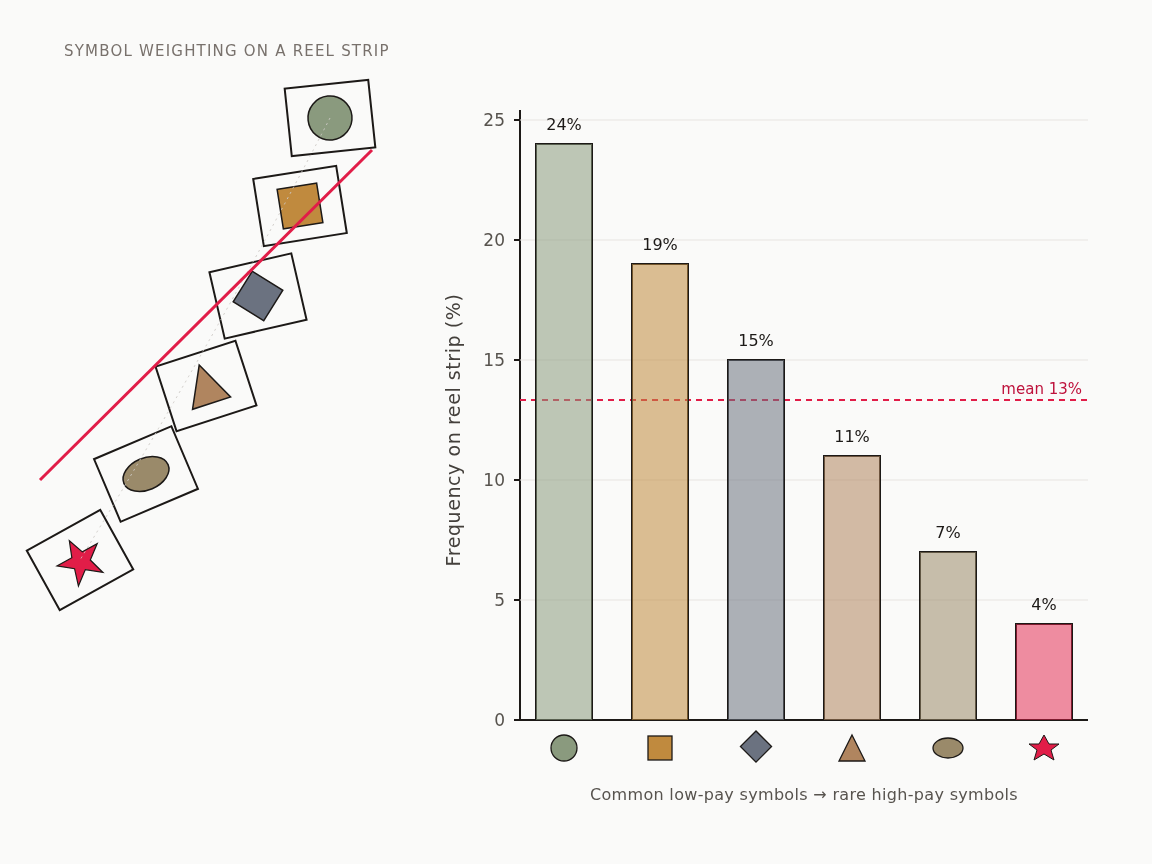
The mechanics of the game — reel strips, feature math, hit frequency — don’t change between configurations; what changes is a weighting applied during certification, so the identical-looking slot returns a different long-run percentage. Practically, this means the RTP you saw quoted on a review site or in a game’s Wikipedia-style database may not be the build running at the casino you’re actually using. The only way to know for certain is the info screen inside that specific casino’s client, for that specific game, on that day.
Theoretical RTP versus what a short session will show
Theoretical RTP is a long-run average built from the complete math model, typically validated against tens or hundreds of millions of simulated spins — it is not a prediction for any single session, hour, or even thousand-dollar run. A slot certified at 96% can easily return 60% or 150% over a few hundred spins; that gap is the normal spread (variance) around a long-run average, not a malfunction.
Two things drive how far a short session can stray from the certified figure: volatility and sample size. A high-volatility slot concentrates its return into rare, large hits, so most short sessions sit well under the theoretical RTP while a small number of sessions sit way over it — the average across all of them still lands near the certified number, but any one visit tells you almost nothing. A low-volatility slot pays more often in smaller amounts, so short-session results cluster closer to the theoretical figure, though still not reliably on it.
Practically: a session of a few hundred spins is not a meaningful test of a slot’s RTP, in either direction. Reading the certified percentage tells a player what the game is built to do over the long haul, not what the next hour holds.
What third-party certification actually verifies
A seal from eCOGRA, iTech Labs, or GLI means an accredited lab ran statistical testing on the random number generator and simulated enough spins to confirm the game’s actual output converges on its stated RTP — not that the operator running the game, the payment processing, or the bonus terms have been checked. These labs typically examine the RNG’s statistical randomness, confirm the paytable and feature-trigger logic matches the submitted math model, and verify that simulated long-run play lands on the published return figure within an acceptable tolerance. UK-licensed operators are required to use a Gambling Commission-approved test house for this work as a licence condition, under the Commission’s remote technical standards and testing strategy.
What certification does not cover: which RTP configuration a given operator has deployed (a provider can certify five tiers of the same game, and the lab’s report applies to all of them individually), whether the operator is honoring the posted RTP in practice over time, and anything about customer-facing issues like withdrawal speed or promotional terms. A “certified fair” badge on a casino’s homepage confirms the math engine was tested — it says nothing about which configuration of that engine the operator chose to run.
A short checklist before spinning
Pull up the slot’s info screen first and confirm the RTP is stated plainly next to the paytable — if it isn’t shown anywhere in the client, that’s worth noting on its own. Cross-check that figure against the studio’s published game sheet or a reputable RTP database if the title is known to ship in multiple configurations (Pragmatic Play, Play’n GO, and NetEnt titles are common examples). Note whether the source is quoting a theoretical/certified number or an “actual observed” number from live tracking, since the two answer different questions. Finally, remember that certification from eCOGRA, iTech Labs, or GLI confirms the math engine was tested to match its stated return — not that any single session will land anywhere near it.